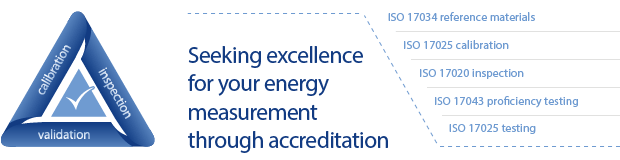
 In order to supply excellent quality service to our customers, EffecTech now holds five accreditations, awarded by the United Kingdom Accreditation Service (UKAS), listed below.
You can also access all of EffecTech’s UKAS accreditation certificates and scopes in our UKAS wallet.
ISO 17034 – Reference Material Producer (5710)
This accreditation covers all reference material manufactured by EffecTech’s production facilities and laboratories – Calibration Gases.
ISO 17025 – Calibration (0590)
This accreditation covers all calibrations carried out in the EffecTech laboratories and on gas quality measurement systems at customers' sites, including calibration gases and performance evaluations – Calibration Gases.
ISO 17020 – Inspection (5710)
This covers the provision of the inspection of gas quality measurement systems – Performance Evaluation and Inspections.
ISO 17043 – Proficiency Testing (4719)
This covers the provision of:
- The Global Gas and LNG Proficiency Testing Scheme (GGLNG) for the oil and gas industry – Global Gas and LNG PT Scheme (GGLNG).
- The Stack Emissions Proficiency Testing Scheme (SEPTS) for stack testing houses – Stack Emissions Proficiency Testing Scheme (SEPTS).

ISO 17025 – Testing (1927)
This accreditation covers the analysis of natural gas from customers' sites to determine the physical properties of the gas – Natural Gas Analysis.
BSI
EffecTech also holds ISO 9001:2015 certification, awarded by the British Standards Institute (BSI).
For more information about BSI, please click here.

Investors in People (IIP)
As part of its commitment to staff development, EffecTech has successfully maintained its Investors in People (IIP) accreditation for over five years.
For more information about Investors in People, please see their website: www.investorsinpeople.com
What is a standard?
The International Standards Organisation website describes an International Standard as a document that “provides rules, guidelines or characteristics for activities or for their results, aimed at achieving the optimum degree of order in a given context. It can take many forms. Apart from product standards, other examples include: test methods, codes of practice, guideline standards and management systems standards.”
- To find out more about ISO see here or their website: iso.org
- To find out more about UKAS, see here or their website: ukas.com
- To find out more about BSI, see here or their website: bsigroup.com
Why are standards and accreditations important?
Organisations that have successfully achieved accreditation to ISO standards have demonstrated their competence through an independent third-party review by their accreditation body. This gives customers confidence that their suppliers are using the latest approved methods and that they deliver what they claim to.
Standardisation helps companies:
- manage complexity
- enhance customer satisfaction
- reduce trade barriers
- assess and compare new and existing technologies against their own requirements as well as their regulatory and contractual obligations
- identify high-quality suppliers easily
Types of ISO Standards
UKAS provides accreditation to conformity assessment bodies that carry out conformity assessment in accordance with standards. Examples of the accreditations that UKAS can award include accreditation as a calibration laboratory (ISO 17025:2005), testing laboratory (ISO17025:2005), inspection body (ISO 17020:2012) and proficiency testing provider (ISO 17043:2010).
Under their accreditations conformity assessment bodies will carry out tasks/activities in accordance with applicable national, European and international standard(s), regulations and guides. For example under EffecTech’s accreditation as a calibration laboratory we can perform the calibration of gas analysers used for natural gas analysis in accordance with ISO 10723:2012.
Standards in gas quality measurement
- ISO 6142 – Gas analysis – Preparation of calibration gas mixtures – Part 1: Gravimetric method for Class I mixtures
- ISO 6143 – Gas analysis – Comparison methods for determining and checking the composition of calibration gas mixtures
- ISO 6974 – Natural gas – Determination of composition and associated uncertainty by gas chromatography
- Part 1: General guidelines and calculation of composition
- Part 2: Uncertainty calculations
- Part 3: Precision and bias
- Part 5: Isothermal method for nitrogen, carbon dioxide, C1 to C5 hydrocarbons and C6+ hydrocarbons
- ISO 23874 – Natural gas – Gas chromatographic requirements for hydrocarbon dewpoint calculation
- ISO 10723 – Natural gas – Performance evaluation for analytical systems
- ISO 12963 – Gas analysis – Comparison methods for the determination of the composition of gas mixtures based on one- and two-point calibration
- ISO 10715 – Natural gas – Sampling guidelines
- BS EN 1776 – Gas infrastructure – Gas measuring systems – Functional requirements
These standards, which currently underpin the use of gas chromatography for gas quality measurement form the basis of many commercial contracts.
 Risks and benefits
The risks associated with not using UKAS accredited evaluators